
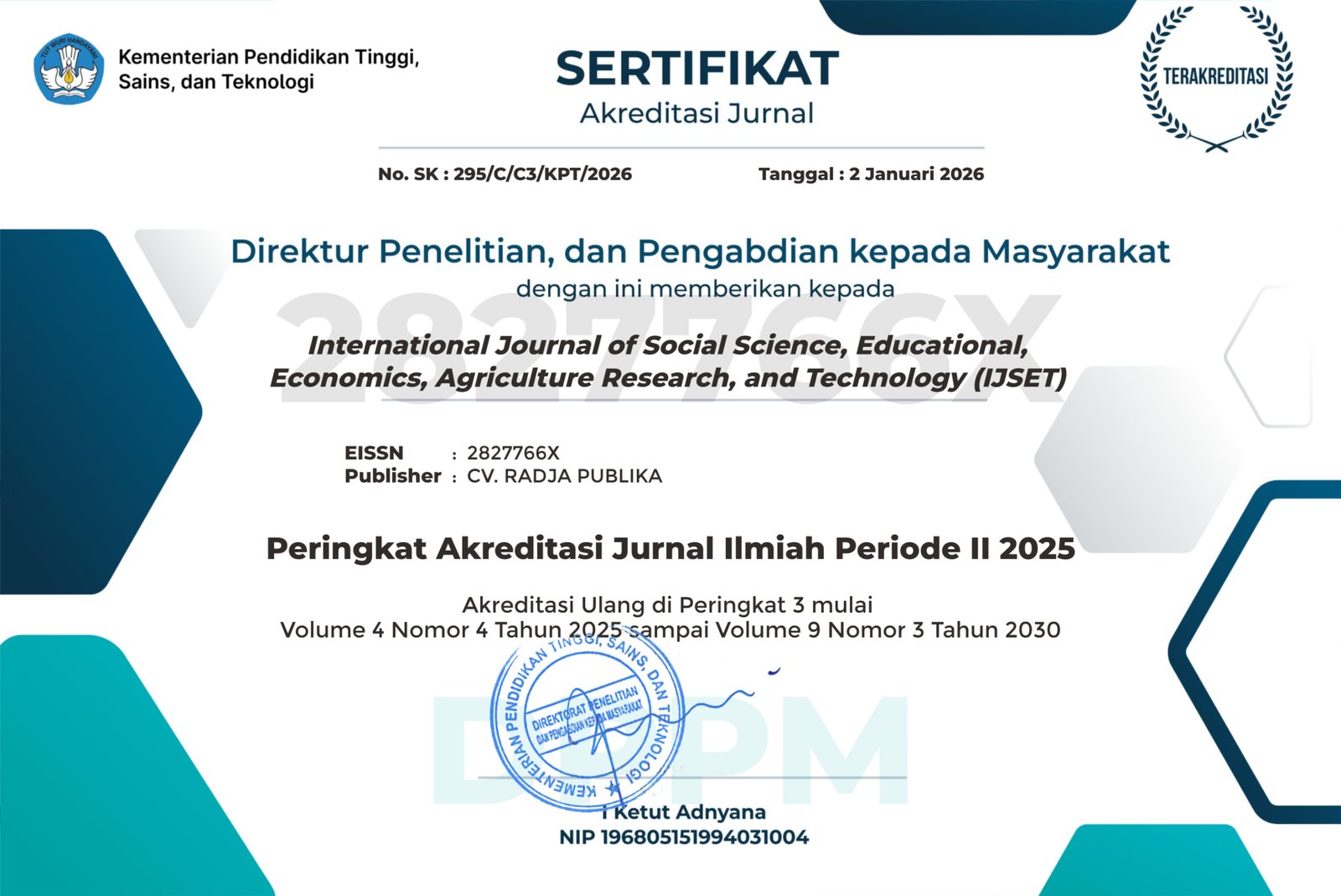









International Journal of Social Science, Educational, Economics, Agriculture Research and Technology (IJSET) recognizes that authors may use Artificial Intelligence (AI) tools (including generative AI and machine-learning-assisted software) to support research and writing. IJSET permits responsible use of AI while ensuring transparency, accountability, originality, and research integrity.
Authors are fully responsible for the content of the manuscript, including accuracy, originality, and compliance with ethical standards.
AI tools cannot be listed as authors because they cannot take responsibility for the work, provide consent, or manage conflicts of interest.
AI use must not compromise confidentiality, participant privacy, or intellectual property rights.
AI tools may be used to:
Improve language clarity (grammar, spelling, readability)
Support editing, formatting, and reference management
Assist with coding support and non-substantive technical checks
Summarize the authors’ own notes or publicly available literature (with proper verification)
Aid in data handling tasks (e.g., cleaning scripts), provided methods are clearly documented and validated
The following practices are not permitted:
Using AI to fabricate data, results, citations, references, or quotations
Generating or manipulating images/figures in a way that misrepresents data (e.g., altering experimental results)
Using AI to produce large portions of the manuscript without author oversight and verification
Uploading confidential manuscripts, peer review comments, or sensitive participant data to AI tools that do not guarantee appropriate privacy safeguards
Using AI to impersonate reviewer/editor feedback or to create fraudulent peer review identities
Authors must disclose the use of AI tools if they:
Used AI to generate or substantially rewrite text, or
Used AI in data analysis, coding, or figure generation beyond basic formatting.
Where to disclose:
Include a statement in the manuscript (e.g., “Acknowledgments” or a separate “AI Usage Statement”).
Example disclosure (writing assistance):
“The authors used [Tool Name, Version] to assist with language editing and clarity. The authors reviewed and edited the content and take full responsibility for the final manuscript.”
Example disclosure (analysis support):
“The authors used [Tool Name, Version] to assist in data cleaning/code generation. All analyses were validated by the authors and are fully reproducible as described in the Methods section.”
If no AI tools were used, authors may state:
“No AI tools were used in the preparation of this manuscript.”
Authors must verify all statements, facts, and references. AI-generated references that cannot be verified are unacceptable.
Sources must be cited from primary literature and credible references.
Any AI-assisted paraphrasing must still include proper citation to the original sources.
Reviewers and editors must not upload submitted manuscripts or confidential materials to AI tools unless the tool is approved by the journal and confidentiality is protected.
Peer review reports must reflect the reviewer’s own assessment. AI may only be used for limited language support, not to replace critical evaluation.
If undisclosed or inappropriate AI use is suspected, IJSET may:
Request clarification or raw data/materials
Require revision and full disclosure
Reject the manuscript
Issue a correction/retraction post-publication in severe cases

International Journal of Social Science, Educational, Economics, Agriculture Research and Technology
This work is licensed under a Creative Commons Attribution 4.0 International License .
Published by:
CV. RADJA PUBLIKA
Jl. Pulo Baroh No.12, Lancang Garam, Kecamatan Banda Sakti, Kota Lhokseumawe
WhatsApp: +6281263081010
Email: radjapublika@gmail.com