
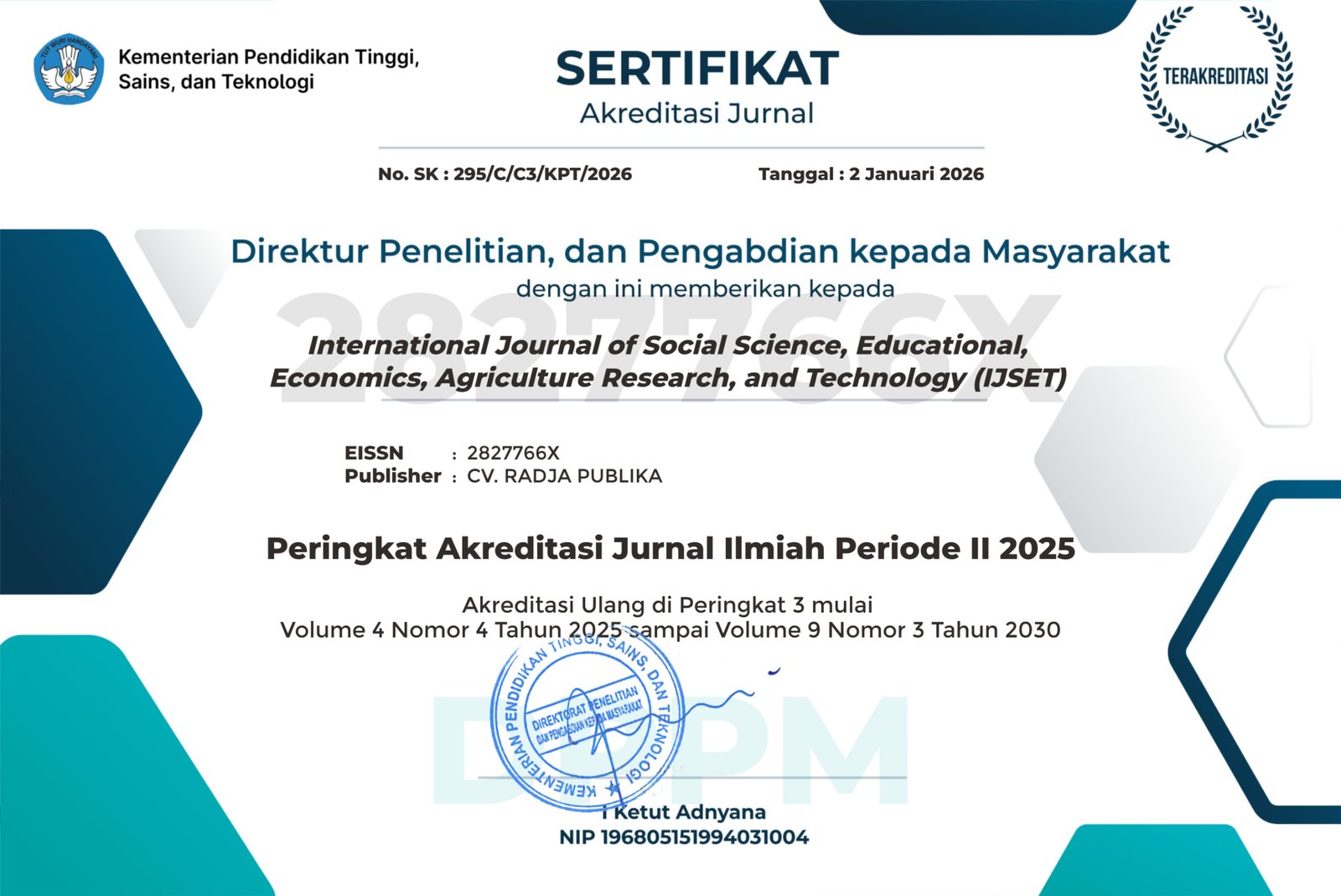









International Journal of Social Science, Educational, Economics, Agriculture Research and Technology (IJSET) is committed to upholding the highest standards of publication ethics and academic integrity. All submitted manuscripts must be original works and must not contain any form of plagiarism, including but not limited to: direct plagiarism, mosaic/patchwork plagiarism, self-plagiarism (redundant publication), and improper paraphrasing or uncited use of ideas, data, figures, tables, or text from other sources.
Every submission will be screened using a plagiarism detection tool (e.g., Turnitin/iThenticate or equivalent).
The editorial team evaluates the similarity report and may exclude references, commonly used terms, and methodological phrases where appropriate.
Authors are encouraged to review their manuscript before submission to ensure proper citation and paraphrasing.
IJSET applies the following similarity thresholds as a guideline (final decisions remain at the Editor’s discretion):
≤ 20% overall similarity: Generally acceptable, subject to editorial review.
21–30% overall similarity: Requires revision (authors must reduce similarity and improve citation/paraphrasing).
> 30% overall similarity: High risk of plagiarism and may result in desk rejection.
In addition to overall similarity, IJSET also considers:
Single-source similarity (e.g., high matching from one source),
Similarity in core sections (abstract, results, discussion, conclusion),
Evidence of copy-paste content, even if overall similarity appears low.
If plagiarism is suspected at any stage (submission, review, or after publication), IJSET will take appropriate actions in line with publication ethics standards:
Before acceptance: the manuscript may be returned for correction, placed on hold, or rejected.
After acceptance but before publication: acceptance may be withdrawn and the manuscript rejected.
After publication: the article may be subject to correction, expression of concern, or retraction, depending on the severity.
The journal may also:
Inform the authors’ affiliated institution(s) if serious misconduct is confirmed.
Ban authors from submitting to IJSET for a certain period in cases of repeated or severe violations.
Authors must:
Ensure the manuscript is original and properly cites all sources.
Use quotation marks for direct quotations and provide exact references.
Clearly acknowledge reuse of any material (including their own previously published work) and provide permissions when required.
Avoid salami publication (fragmenting one study into multiple papers) and duplicate submission/publication.
Editors and reviewers are required to:
Maintain confidentiality and report any suspected plagiarism or ethical concerns to the editorial office.
Ensure decisions are based on academic merit and ethical compliance.
Authors may submit an appeal regarding plagiarism decisions by providing:
A written explanation,
Evidence of originality and proper citations,
A revised manuscript (if requested).
All appeals will be reviewed by the Editor-in-Chief and/or the editorial board, and the decision will be final.

International Journal of Social Science, Educational, Economics, Agriculture Research and Technology
This work is licensed under a Creative Commons Attribution 4.0 International License .
Published by:
CV. RADJA PUBLIKA
Jl. Pulo Baroh No.12, Lancang Garam, Kecamatan Banda Sakti, Kota Lhokseumawe
WhatsApp: +6281263081010
Email: radjapublika@gmail.com