
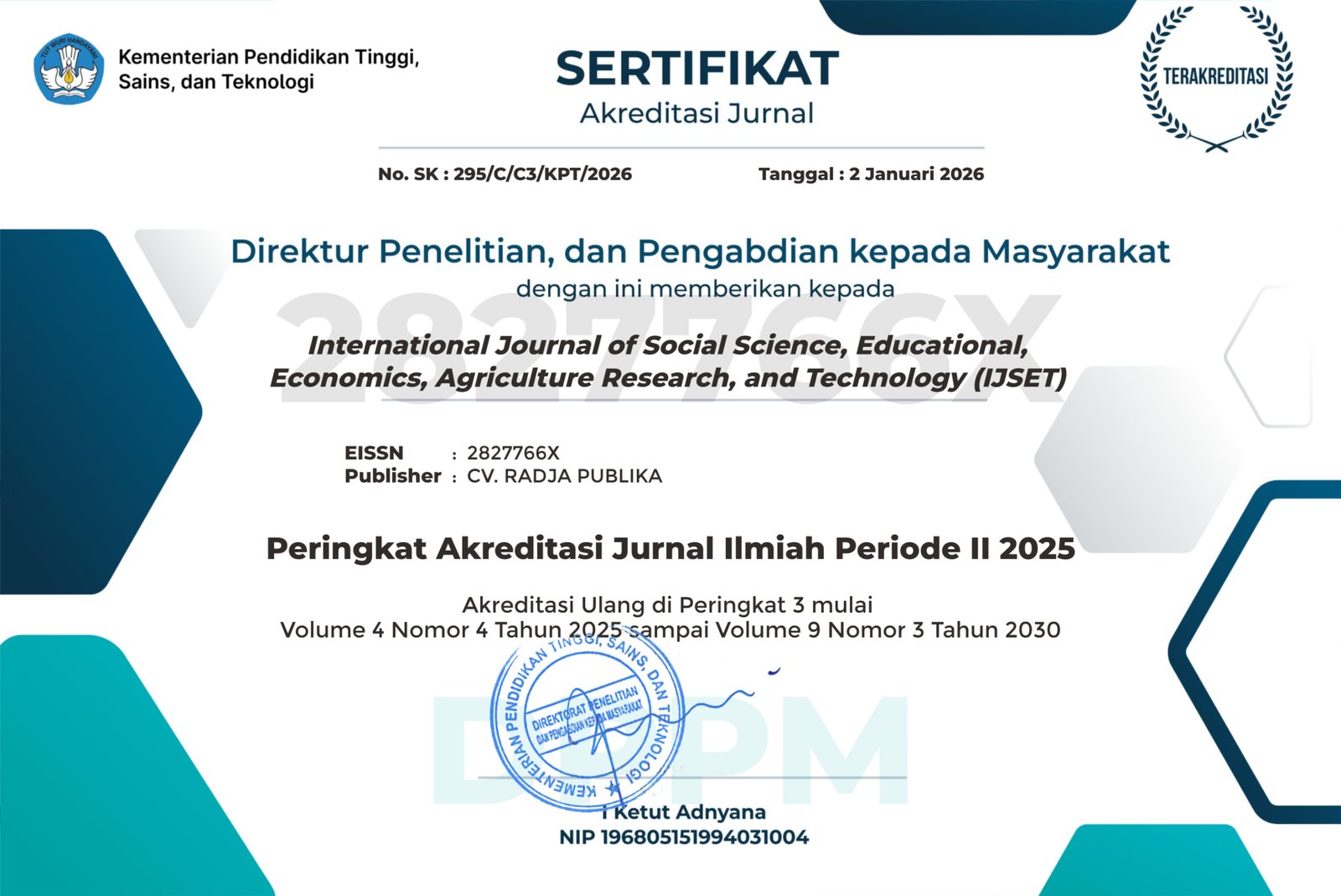









International Journal of Social Science, Educational, Economics, Agriculture Research and Technology (IJSET) is committed to ensuring transparency, objectivity, and integrity in the publication process. All parties involved in the publication process—authors, reviewers, editors, and editorial board members—must disclose any actual, potential, or perceived conflicts of interest (COIs) that could influence their work.
A conflict of interest occurs when personal, financial, professional, or institutional relationships could inappropriately influence (or be perceived to influence) decisions, actions, or interpretations related to a manuscript.
Examples include:
Employment, consultancy, honoraria, paid expert testimony
Stock ownership, grants, patents, royalties
Paid speaking engagements, sponsorships, or funding tied to the study
Examples include:
Personal relationships, family ties, close friendships, or adversarial relationships
Academic competition, rivalry, or strong intellectual beliefs
Institutional affiliations that may benefit from the publication outcome
Political, religious, or ideological positions that may bias interpretation
Authors must:
Declare any conflicts of interest in the manuscript (COI/Declaration section).
Clearly state all sources of funding and the role of funders (if any) in study design, data collection, analysis, and publication decisions.
Confirm that disclosure is complete and accurate for all co-authors.
If there are no conflicts, authors must include a statement such as:
“The authors declare no conflict of interest.”
Reviewers must:
Declare conflicts of interest before accepting a review assignment.
Decline the review if they have a COI, including:
Recent collaboration with the author(s)
Same institution/department affiliation
Close personal relationships or direct competition
Maintain confidentiality and not use manuscript information for personal advantage.
Editors and board members must:
Avoid handling manuscripts where a conflict exists (e.g., same institution, collaborators, personal relationships).
Assign an alternative editor to manage the manuscript when a COI is identified.
Ensure editorial decisions remain independent and based only on academic merit and journal standards.
If a conflict is disclosed or identified, IJSET may:
Request additional clarification from authors/reviewers/editors
Reassign editors or reviewers to ensure neutrality
Publish a COI statement alongside the article when relevant
Reject a manuscript if undisclosed COIs compromise research integrity
Failure to disclose relevant conflicts may result in:
Manuscript rejection (pre-publication)
Publication of a correction/COI update
Retraction in severe cases where the integrity of the work is compromised

International Journal of Social Science, Educational, Economics, Agriculture Research and Technology
This work is licensed under a Creative Commons Attribution 4.0 International License .
Published by:
CV. RADJA PUBLIKA
Jl. Pulo Baroh No.12, Lancang Garam, Kecamatan Banda Sakti, Kota Lhokseumawe
WhatsApp: +6281263081010
Email: radjapublika@gmail.com