
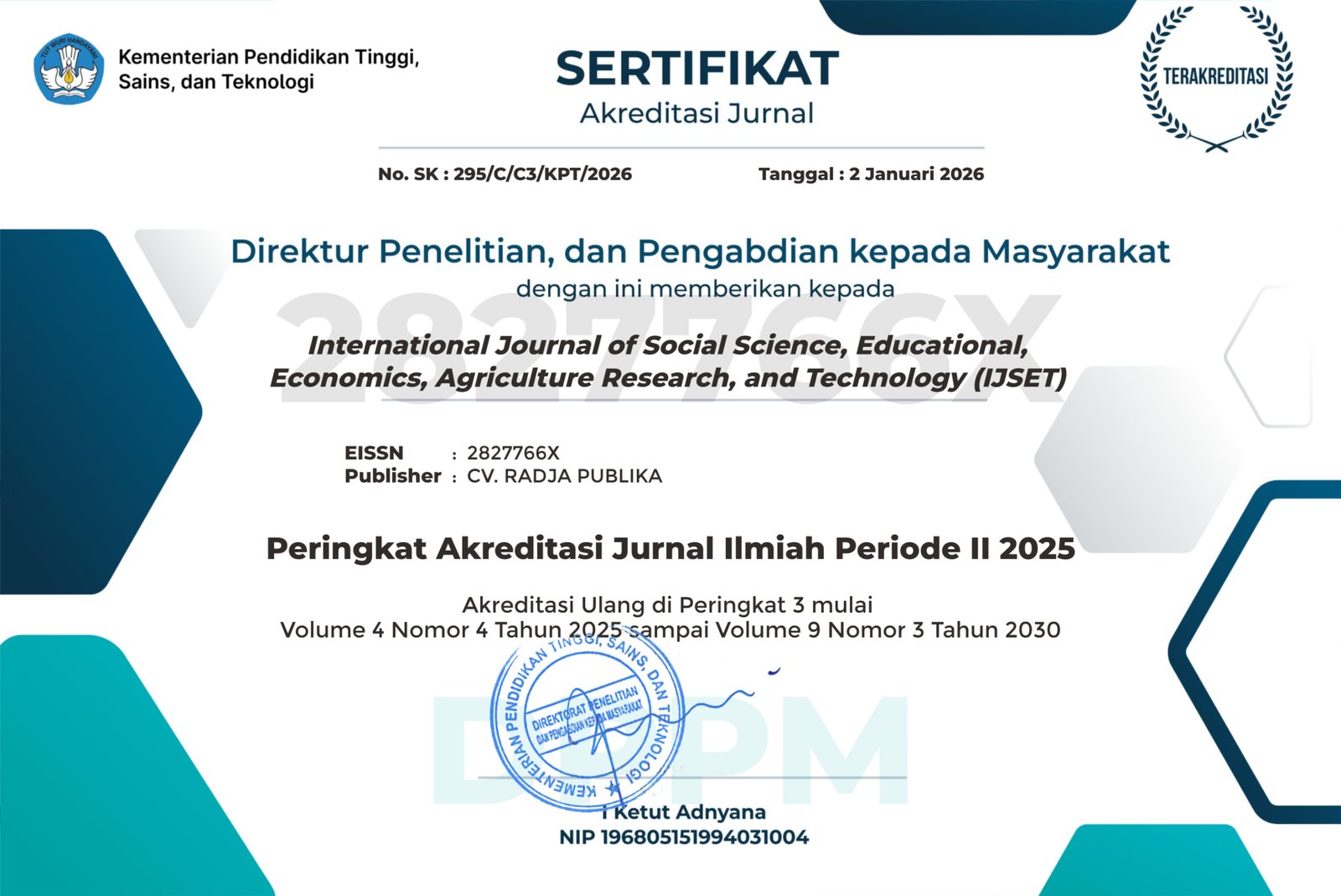









International Journal of Social Science, Educational, Economics, Agriculture Research and Technology (IJSET) is committed to maintaining the integrity of the scholarly record. When errors, ethical issues, or research misconduct are identified in a published article, IJSET will take appropriate action through corrections, retractions, or expressions of concern, following internationally recognized publication ethics standards.
A Correction is issued when a published article contains an error that:
does not invalidate the overall findings or conclusions, but
requires clarification or amendment to ensure accuracy and transparency.
Examples:
Minor factual errors, typos affecting meaning, author details, affiliations
Incorrect figure/table labeling
Missing acknowledgements or minor reference errors
A Retraction is issued when an article is found to be unreliable due to:
major errors (unintentional) that invalidate results/conclusions, or
research misconduct or serious ethical violations.
Examples:
Fabrication, falsification, or manipulation of data
Plagiarism or severe self-plagiarism/duplicate publication
Unethical research (e.g., missing consent/approval where required)
Copyright infringement or unauthorized use of material
Serious methodological errors that render conclusions invalid
An Expression of Concern may be published when:
there is credible evidence of a potential problem, but
the investigation is incomplete or unresolved.
IJSET may consider issuing a correction or retraction based on:
Author request supported by valid evidence
Reviewer/editor findings post-publication
Reports from readers, institutions, or third parties
Outcomes of ethical investigations
Initial Assessment: The Editor-in-Chief reviews the complaint or evidence and may request additional documentation.
Author Notification: Authors will be contacted and given an opportunity to respond within a reasonable timeframe.
Ethics Review: If necessary, the case will be reviewed by the editorial board and/or independent experts.
Institutional Involvement: In serious cases (e.g., misconduct), IJSET may contact the author’s institution or relevant authority.
Final Decision: The Editor-in-Chief makes the final decision based on evidence and ethical considerations.
A correction notice will be published in the journal and linked to the original article.
The notice will clearly describe what is being corrected and why.
The original article remains accessible, and any updated PDF will be marked clearly (e.g., “Corrected on [date]”).
Metadata and indexing records will be updated where possible.
A retraction notice will be published promptly, with a clear explanation of the reason for retraction.
The retraction notice will be linked to the original article, and the original article will link back to the notice.
The original article will remain available to preserve the scholarly record but will be clearly watermarked/labeled as “Retracted”.
Indexing services and archives (where applicable) will be notified to update records.
Authors may request retraction if they identify serious issues post-publication. IJSET will evaluate the request and supporting evidence. Retraction will not be granted solely to avoid criticism, disputes, or unfavorable results.
Authors may appeal editorial decisions related to correction or retraction by submitting:
A written appeal with supporting evidence and documentation
The appeal will be reviewed by the Editor-in-Chief and/or editorial board. The decision after appeal is final.
IJSET aims to handle correction and retraction cases in a timely, fair, and transparent manner while maintaining confidentiality during investigations.

International Journal of Social Science, Educational, Economics, Agriculture Research and Technology
This work is licensed under a Creative Commons Attribution 4.0 International License .
Published by:
CV. RADJA PUBLIKA
Jl. Pulo Baroh No.12, Lancang Garam, Kecamatan Banda Sakti, Kota Lhokseumawe
WhatsApp: +6281263081010
Email: radjapublika@gmail.com