
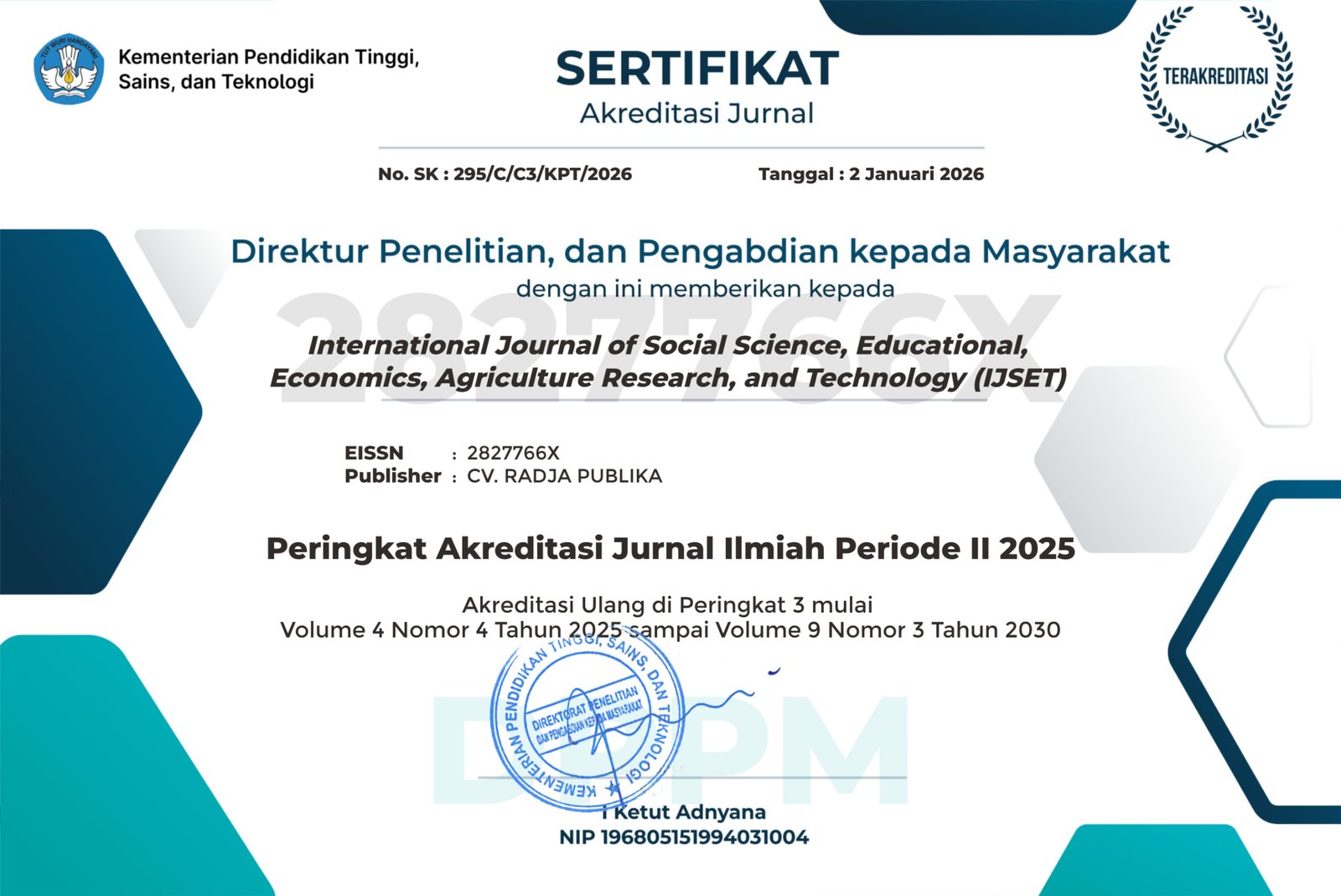









International Journal of Social Science, Educational, Economics, Agriculture Research and Technology (IJSET) supports research transparency and encourages practices that improve the reliability, verification, and reproducibility of published findings. Authors are expected to provide sufficient information to allow readers to understand, evaluate, and, where feasible, reproduce the reported results.
Authors are encouraged to make the underlying data available to readers whenever possible. Data may be shared through:
Institutional repositories
Public or discipline-specific repositories
Supplementary files on the journal website (when appropriate)
Upon reasonable request (when open sharing is not possible)
Authors must include a Data Availability Statement in the manuscript describing where and how the data can be accessed.
Example statements:
“The data supporting the findings of this study are available in [Repository Name], [DOI/Link], under [license/terms].”
“The datasets generated during and/or analyzed during the current study are available from the corresponding author on reasonable request.”
“Data are not publicly available due to [reason: privacy/ethical/legal restrictions], but can be accessed under controlled conditions upon request.”
Authors must provide clear and complete methodological details, including:
Study design, sampling procedures, and data collection methods
Instruments used (questionnaires, interview guides, observation sheets), including validity/reliability evidence when relevant
Experimental or field procedures (for agriculture/technology research)
Key parameters, assumptions, and model specifications
Software/tools used (including version numbers)
When possible, authors should provide appendices or supplementary materials (e.g., instruments, protocols) to support replication.
For studies involving computational analysis, authors are encouraged to share:
Analysis scripts or code (e.g., R, Python, SPSS syntax, Stata do-files)
Model code, simulation code, or algorithm details
Software version and packages used
If code cannot be shared publicly (e.g., proprietary constraints), authors must describe how results were produced and what restrictions apply.
IJSET recognizes that reproducibility requirements vary across disciplines. Authors should ensure that:
Results are reported clearly with appropriate statistical details (e.g., effect sizes, confidence intervals, p-values where applicable)
Tables/figures are supported by accessible underlying data where feasible
Claims are consistent with evidence and methods are described sufficiently for verification
If data contain sensitive information (e.g., personal identifiers, confidential institutional data, or protected community data), authors must:
Remove direct identifiers and apply appropriate anonymization/de-identification
Follow relevant ethical approvals and consent procedures
Share data only in compliance with applicable regulations and participant protections
In such cases, IJSET supports controlled access or data-sharing agreements rather than unrestricted public release.
The journal may request additional materials to support verification, such as:
Raw or de-identified datasets
Ethical approval documentation (if applicable)
Original instruments or protocols
Analysis code or logs
Failure to provide supporting materials when reasonably requested may affect editorial decisions or lead to post-publication actions.
Authors are encouraged to:
Register study protocols when relevant (e.g., evaluations, interventions)
Use recognized reporting guidelines when applicable (e.g., PRISMA for systematic reviews)
Provide transparent limitations and potential sources of bias
Any evidence of data fabrication, falsification, or misrepresentation is treated as serious misconduct and may result in:
Rejection before publication
Correction, expression of concern, or retraction after publication

International Journal of Social Science, Educational, Economics, Agriculture Research and Technology
This work is licensed under a Creative Commons Attribution 4.0 International License .
Published by:
CV. RADJA PUBLIKA
Jl. Pulo Baroh No.12, Lancang Garam, Kecamatan Banda Sakti, Kota Lhokseumawe
WhatsApp: +6281263081010
Email: radjapublika@gmail.com